



Development world is now abuzz with the advent of artificial intelligence. What will AI mean for the 6.8 billion people who live in low and middle income countries?
The forecasts, even from normally staid development institutions, range from optimism to despair. The World Bank’s flagship 2026 World Development Report describes AI as “a lifeline [developing countries] should grasp before it slips away”. The UN Development Programme sees the opposite, warning that AI is “heralding a new era of rising inequality between countries” after fifty years of convergence.
Clearly, speculation is racing ahead of research.1 We are starting to get some scattered evidence about Indian call center employment and experiments on the effects of AI tools in low-income settings—but empirical work, by its nature, can only be backward-looking. To plan for the future, we need theoretical frameworks that can help us identify the deep structural forces.
This post takes a modest first step. We borrow one of the oldest and simplest frameworks in international trade, the Heckscher-Ohlin model, to try to understand what AI will do to the gap between rich and poor countries. The implications for global inequality are surprising.
Why Heckscher-Ohlin?
For the past century, the Heckscher-Ohlin model has been economists’ workhorse model to understand what trade does to wages in rich and poor countries.
The Hecksher-Ohlin model views the world purely through the lens of factors of production, like land, capital, and labor. In the conventional setup, rich countries have abundant capital and skilled labor, while poor countries have natural resources and unskilled labor.2 This makes it a natural choice to analyze how AI, a technology owned by rich countries and deployed in poor countries, could affect wages.
Heckscher-Ohlin’s basic prediction is that countries will specialize in goods that intensively use what they have in abundance, while importing goods that depend on factors that they lack. In plain English, countries will cook recipes which use the ingredients sitting in the cupboard. Bangladesh, where most workers lack an extensive formal education, exports t-shirts; Taiwan, which is rich in highly educated engineers, specializes in microchips.
One of Heckscher-Ohlin’s starkest predictions is that trade will equalize wages between countries for the same type of labor. Scientists in Taiwan will make as much as scientists in the US, because the goods they produce are traded internationally at the same price. Skilled workers earn more than unskilled workers, with the “skill premium” determined by the global supply of unskilled labor vs skilled labor.
Thus, income differences between countries result entirely from (a) their mix of skilled versus unskilled workers and (b) the premium paid to skilled workers. Any productivity shock, including AI, will affect the global income distribution through these two channels.
This prediction that wages for each type of worker are equalized across countries is of course far from true in the real world. Nonetheless, the model is a helpful intuition pump to follow the implications of AI-led automation to the extremes.
Wage Convergence, Not Divergence
Consider the following simple Heckscher-Ohlin setup. A full write-up with the math (written, appropriately enough, with some help from Claude) is here.
Imagine there are two countries, North and South, and two factors of production, skilled labor and unskilled labor. The North has abundant skilled labor and the South has abundant unskilled labor; the North is richer than the South because it has more skilled workers.
Let’s add AI to the mix. A defining feature of the world circa 2026 is that rich countries specialize in the production of bits—spreadsheets and emails—while poor countries specialize in the production of atoms—coffee, garments, cobalt. —(We can also think of the former as cognitive labor, the latter as physical labor.) It’s still early days, but the signs are that AI will impact the world of bits before the world of atoms. Thus, we model AI as a substitute for skilled labor, while leaving unskilled labor untouched.
Imagine that AI can perfectly substitute for skilled workers, and that its supply goes to infinity, performing a rising share of the world’s skilled work. What happens then to wages in the North and the South?
Here’s where the structure of the model is helpful: Heckscher-Ohlin predicts that as productivity of AI goes to infinity, the wage gap between rich and poor countries will decrease.
This flies in the face of the initial intuition of most people (including me) that technological acceleration will cause wages in rich and poor countries to diverge. But when AI can substitute for skilled labor, the global stock of skilled labor becomes abundant. This drives down the wage paid to skilled labor, and drives up the wage paid to unskilled labor (since it is a complement to skilled labor).
In extremis, if AI labor becomes infinitely abundant, the skill premium goes to 0—skilled workers will make as much as unskilled ones. Because rich countries have more skilled labor and poor countries have more unskilled labor, this erosion of the skill premium causes wages to converge between rich and poor countries.
Thus, the intuition that AI automation will increase global wage inequality appears wrong. Perhaps the global poor should embrace the rise of the machines?
Who Owns the Machines?
Not quite. We have glossed over a critical question—who owns the gains from AI? When AI replaces skilled labor, the profits flow instead to the owners of the models, energy, and data centers on which the new AIs run. Who owns AI turns out to be crucial for determining the direction of impact on global inequality.
In our model, we assume that the North owns 80% of global AI rents, while the South owns 20%. (The specific numbers are less important than the fact that the North owns the vast majority of AI.)
The graph below shows how incomes in North and South evolve based on the share of skilled work that can be performed by AI (along the x-axis). Northern incomes sit above the 0 line; Southern incomes sit below it. Wages are colored in blue, while AI rents are colored in orange:
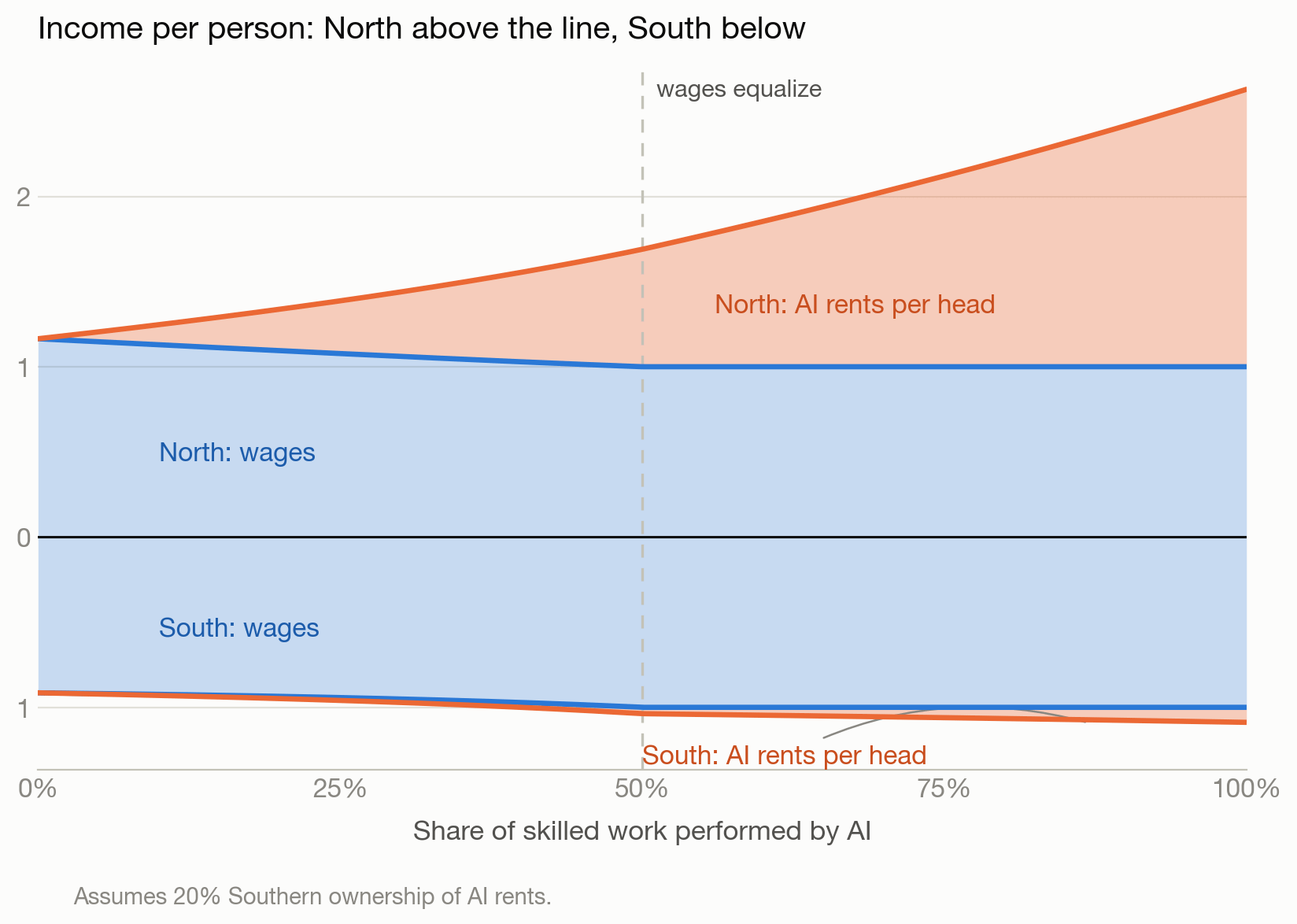
Even though wages converge between North and South, AI rents emerge as a new source of divergence. We see wage convergence but income divergence.
The key lever to prevent this divergence is for the South to have a larger ownership claim over AI rents. So how much Southern ownership is needed for AI to reduce global inequality?
The relative incomes of North and South are given by:
North-South income ratio = (Northern wage + Northern AI rent per head) / (Southern wage + Southern AI rent per head)
We can plot how this North-South income ratio evolves, depending on the share of world AI rents owned by the South:
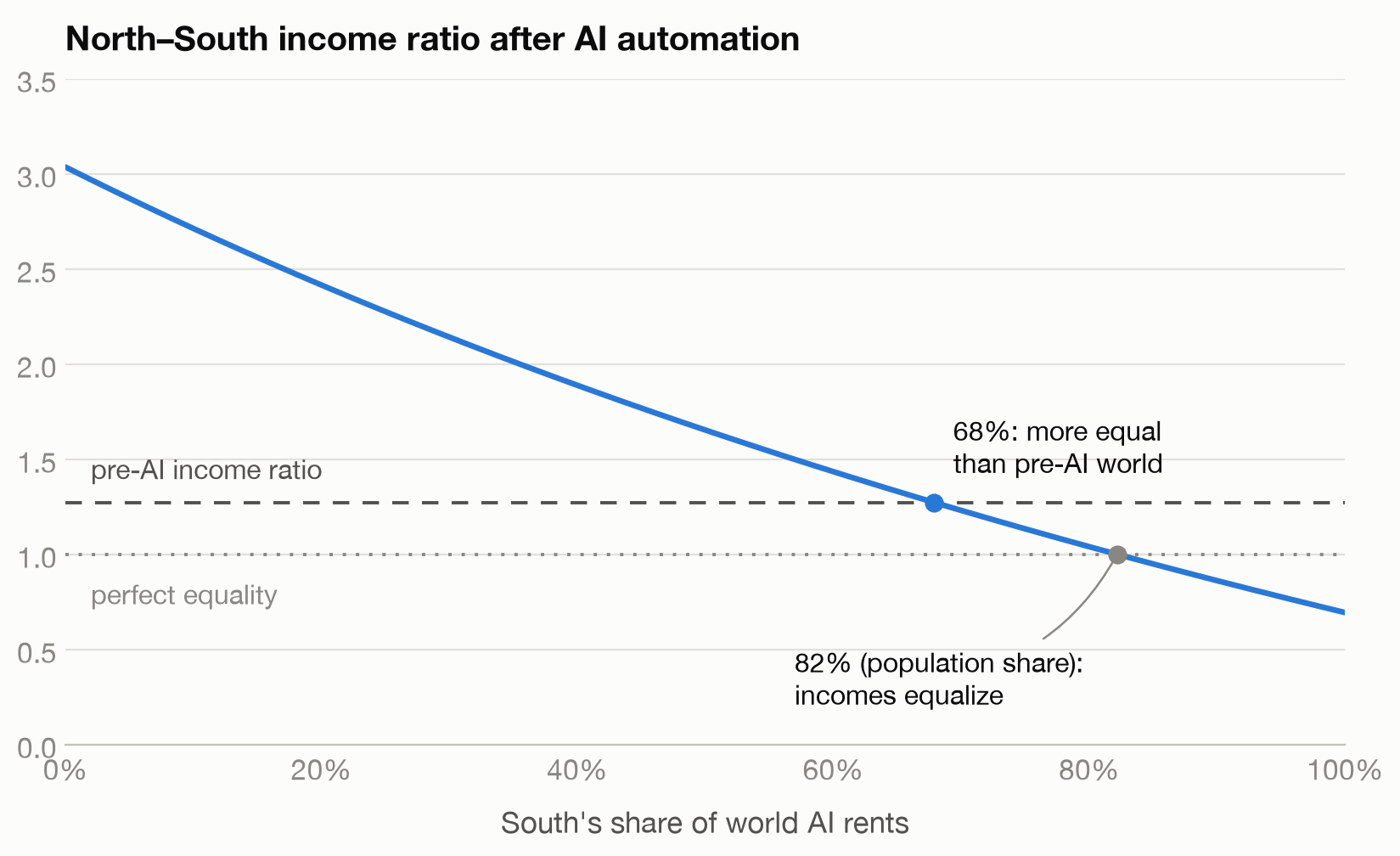
In order for the advent of AI not to increase global inequality, the South has to own around two-thirds of the global rents from AI. The exact threshold for the South to be made better-off depends on the parameters of the model, but the broad takeaway is that income convergence demands that the South own a share of capital that is far higher than is true in reality.
Why is this threshold so high? Intuitively, most of the world lives in the South, so it needs to own most of the world’s AI rents in order to benefit from AI on a per-capita basis. Wage convergence gives the South a head start (which is why convergence doesn’t require an ~80% ownership share, proportionate to the Southern share of world population), but it can’t close the gap on its own.
Given that the South currently holds a low single-digit share of global AI capital, we are unlikely to move above the threshold soon. In this model, under current ownership patterns—where models, chips, and hyperscaler data centers remain overwhelmingly Northern-owned—AI will increase the gap between the Global North and South, even as it compresses the global wage distribution.
Note that, in this model, the South does not get poorer in absolute terms. It is likely that these countries will grow richer, as the production input that they are scarcest in (skilled labor) becomes abundant. But global inequality will nonetheless increase.
Two Key Questions
The purpose of a good theory is to cut through the noise: to point us to what we should focus on, and what we can ignore. Heckscher-Ohlin helps us hone in on two key questions when analyzing AI’s effect on global inequality:
What type of labor is automated by AI? If AI automates skilled labor that rich countries are relatively rich in, wages will converge between rich and poor countries—an unexpectedly progressive effect.
Who owns the gains from AI? Even though the theory focuses on labor, the most important determinant of global income distribution is AI ownership. AI automation makes capital rents more important than labor income, so developing countries need to acquire more capital to prevent divergence.
So while it is likely that AI will increase global inequality, it is important to be clear about why: inequality will arise from the unequal distribution of AI ownership and its concentration in rich countries. In this world, what matters most for a developing country’s future income is owning a claim on AI rents.3
Global redistribution of AI gains towards poor countries also serves the same purpose as AI ownership. Though developing countries (unfortunately) don’t have much of a say in this, it is a policy prescription that those of us living in rich countries (particularly the United States) can potentially advocate for. Plans like AI 2040 have suggested that the US engage in this kind of redistribution.
What does this model get wrong?
All models are wrong, so the saying goes, but this one is especially wrong.
First, it attributes global inequality to the differences in skill composition between the North and the South. This is certainly one source of global income differences, but it’s not the only one. Roughly speaking, the development accounting literature attributes half of global income differences to skills.4 As a result, the model captures how AI will affect a key channel of global inequality, but not the only channel.
Second, we assume that AI is a substitute for skilled labor—human beings can be swapped out for machines without end. But a reasonable alternative hypothesis is that AI is a complement to skilled labor. If this is the case, skilled labor will again be a beneficiary, creating further divergence between the Global North and South. The automation-augmentation debate around labor impacts in the US has global implications.5
Third, the model is static. There is no growth, no capital accumulation, no development ladder. The actual history of catch-up growth involves countries changing their skill endowments, ascending from less complex commodity sectors to more complex high-margin sectors. The model can’t capture how AI affects this dynamic process.
But it’s worth dwelling for a moment on the full implications of the convergence result. In one of the workhorse theories of trade, in the modal scenario of AI anxiety among the Silicon Valley set, the arrival of AI will be a force for wage compression between rich countries and poor—by immiserating skilled labor everywhere. But this alone is not enough to determine whether income inequality will increase .The rents from AI are where the fate of global inequality will be decided.
This piece was co-authored with Karthik Tadepalli of GovAI and Joseph Levine of Google DeepMind. The views expressed are solely those of the authors.
The closest academic paper studying this question is Alonso, Berg, Kothari, Papageorgiou, and Rehman (2022), who model robots that substitute for unskilled labor and find divergence. A newer generation of quantitative trade models (Cerutti et al. 2025; Filippucci et al. 2026; WTO 2025) use AI-exposure measures to map rich-country AI productivity shocks through trade channels and find modest, uneven spillovers to lower-income countries. See also Korinek and Stiglitz (2021) on AI, globalization, and development strategy, and Proença (2026) on the welfare consequences of divergence.
“Skilled” and “unskilled” are somewhat unfortunate terms that are nonetheless commonly used by economists. There is nothing that is “unskilled” about sewing a t-shirt, or scratching a living out of the earth as a subsistence farmer. (I’ve written about the working conditions by supposedly “unskilled” workers in Ethiopia.) Perhaps a more accurate delineation would be “jobs requiring a formal education” and “jobs that do not require a formal education”.
“AI ownership” does not imply that developing countries need to make their own AI models, or that that is even a good idea. We use “ownership” here to mean achieving a foothold in the AI supply chain, gaining an income stream whose value increases with AI progress.
Hosting foreign-owned data centers on developing country soil fails on those grounds. Foreign-financed data centers will pay the host country for their leases and electricity. These costs are largely fixed regardless of AI’s value. Higher-margin rents, on the chips and models, flow to the capital-owners from the North.
Thus, low-income countries should focus on building out and owning whatever part of the AI supply chain is most feasible for them. Anton Leicht goes into more detail about how middle powers can use industrial strategy to enter the AI supply chain, though he warns that no foothold is permanent.
This is the “development accounting” debate, in which some researchers argue over attributing cross-country income differences to “human capital” vs “productivity”. The former is what we’ve labelled skill composition, while the latter encompasses all channels that are not labor or physical capital. This has historically been a contested literature with noisy data, but the most recent evidence argues that they are equally important.
Additionally, if the supply of artificial skilled labor is unlimited and there is a market for it, the price of skilled labor falls to the marginal cost of providing it (~the cost of electricity). In that case, the surplus goes to users rather than capital owners. The rents driving the overall divergence persist only with assumptions (fair ones, we think) about market structure.
I think it's interesting to think about the timing of these events: it seems like AI will initially impact skilled labour a lot more, but will also initially be a complement rather than a substitute to skilled labour (for example, it seems like right now, the demand for software has gone up a bit, and while new software opportunities are low, employed software engineers are doing fine), and by the time we get the substitution effect, we will also start to see AI capabilities impacting unskilled labour, where I expect it to be more uniformly a substitute (since the demand for physical goods seems more fixed). Anyway, I found the initial result fairly counterintuitive, and thus found this to be a very interesting read and will continue to think about it more.
"Heckscher-Ohlin’s basic prediction is that countries will specialize in goods that intensively use what they have in abundance, while importing goods that depend on factors that they lack. In plain English, countries will cook recipes which use the ingredients sitting in the cupboard. Bangladesh, where most workers lack an extensive formal education, exports t-shirts; Taiwan, which is rich in highly educated engineers, specializes in microchips." And many countries like India that have workers with formal education & highly educated engineers, are unable to be competitive garment exporters nor can manufacture microchips – so much for the model!